
*Warning, this is something of a rant*
In my opinion gameplay shouldn't be complimented by roleplaying. It should be the other way around. Game mechanics should be designed around the narrative/roleplaying in the game.
One of my favorite experiences as a GM was actually running a relatively short-lived D&D 4th edition game with a few of my friends. There was a tale about an “emotional plane” (home-brewed stuff of course) colliding with our. One of the fights was against a “Insanity Elemental”. He had 3 little “invokers” which could activate an “insanity” effect on the players. I knew the players pretty well so I tossed out the rules for “insanity” from the PHB and went for something more abstract. If he successfully effected them with this spell-like ability they would become “insane”. An insane character got a save at the end of their turn (10+ ends) but one of their actions was controlled by the GM. (Movement, standard, free, ect) By describing the various things that MADE THEM INSANE I didn't even have to take the action for them by the end of the fight! For instance, the spell caster had a lava-lamp like thing apparently smothering him so the only obvious answer to his character was to magic-missile himself in the face to get it off. (his choice- not mine) Another one actually took off his armor and got naked due to the apparent seething flames belching forth from his armor. It was an example of rules almost coming about as a result of good roleplaying.
In that same campaign the players where effected by a “Lust Elemental” who compelled every member of the party to seek out “the dagger”. The players didn't know WHAT “the dagger” was but (as our mantra became that session) they “really wanted the dagger”. EVERY question about it ended with the line “...but/and you really want the dagger.”. Even when the players where doing something completely unrelated I would bug them for a moment and say something like:
“Hay Andrew“
“What?”
“Do YOU want the dagger?”
“Um.. I don't know? Do I?”
“Yes... you want the dagger”
“STILL”
“Yes.”
“Hay Alissa“
“O god...”
“Do YOU want the dagger?”
“*Sigh* Yes”
“That's right... you want the dagger”
This went on for the ENTIRE session, to the point where there was no need to use any in-game mechanics to FORCE them to roleplay a magical compulsion towards the dagger- they simply wanted the dagger. In the end it was actually another lust elemental who had turned herself into a dagger. I didn't even bother to make rules for the magical compulsion- the players just really wanted the dagger. It was an interesting experience, the roleplaying guided the group to almost make rules for themselves. I guess if you paint a vivid enough picture or make something EXCESSIVLY reprehensible then you can guide a game simply by roleplay rather than by clunky rules. Do I think this would work for a group of inexperienced roleplayers? No. The people I had with me where all excellent and where doing this out of sheer enjoyment- but that's how pen and paper games should be right? Just sitting around laughing you ass off while playing a compelling game. To this day when I talk to the players they still something ask “By the way, do I want the dagger?” and all I can do is smile and say “Yes! You REALLY want the dagger.”
Monday, April 12, 2010

Pathfinder Extra
I had an entire campaign written up for a group that never ran so I'll toss it up on the site. I know I've been going on a lot about Pathfinder lately but I've taken a shine to it. It's D&D 3.5 fixed (more or less), kinda like what Hackmaster did to AD&D. I've gotta say- it's pretty fun. I like it a bit more than 3.5 and certifiably bad ass when compared to 4th edition's MMO-ness. (Sure it's quicker... but I'm a fan of rules upon rules upon rules :D I'm a wargammer damn it! Don't screw with the good parts!) What follows is a kinda smattering of the interesting bits from the campaign setting:
Racial Lore: Vættir (Vet-te-ear)
Elves and Dwarves are of the same race (collectively called “Vættir”). Their origins are unclear; however they seem to have been influenced a great deal by magic at some point in their evolution. All Elves are female (in fact in Vættir “Elf” means “Female” generally) and all Dwarves are male. This is something of an extreme example of sexual dimorphism. They generally live in separate communities and more often than not- dislike each other a great deal. (Courtship is extremely difficult…) Vættir never are subject to death though aging- though their bodies do eventually weaken and they become more accident prone. In regards to mixed breeding with other races, the daughter of an elf is always a full blooded elf. A half-elf is always male (and normally laughed very hard at by Dwarves). The son of a Dwarf is always a Dwarf. The daughter of a dwarf is a half dwarf (Counted as “Halfling” but has the familiarity with the weapon family “Dwarf” instead of Halfling). It should be noted that half-breeds are sterile.
Homebrewed Special Rules:
“Only wicked shall perish.”
Those who revere the Divine Father (or whatever deity you are interested in) are subject to his protection. In his eyes, those who are wicked (even temporarily) are undeserving of his graces. Those who uphold his tenets and act in the name of justice should never fear the blade of the wicked. To represent this characters that follow the Divine Father stabilize on charisma roll of 15+ if they are of the good alignment. If they are neutral they use the normal rules for going below zero. Players who worship the Divine Father who fall to the evil alignment instantly die when they reach zero hit points. Following another deity shifts you to evil alignment to evil (as you have betrayed your deity). The Divine Father objects to his people using any other deity’s power. Willfully seeking the blessing of another deity shifts your alignment towards Evil. To the Divine Father, Magic is a sick blight on the planet- tainting pure ideals with it’s influence. Using a magic automatically shifts your alignment towards Evil.
“All things are temporary.”
In this setting alignment is a shifting aspect of one’s personality. An evil act could easily drop a character from a good alignment to a neutral or possibly evil alignment depending on its severity. However, more redemption is just easily obtained.
“Magic is learned, not earned.”
Spell casting classes must be multi-classed into. You must find a teacher as a prerequisite. (This also goes for the magical rogue talents and all magic feats.)
“Burn the Witch!”
The exception to the above rule is Sorcerer. Sorcerers are generally looked upon with disdain, their raw magical talents are (especially in some parts of the world) looked upon as an inherent impurity. If you wish to play a Sorcerer you must do so at first level.
-The Divine Father (LG)
Domains: Glory, Good, Law, Healing, War, Nobility
Mysteries (Oracles): Battle, Heavens
Favored Weapon: Longsword
Design notes on the above:
Feel free to change the fluff, the constantly changing alignment is fun as well as the “only the wicked shall perish”. Note that Paladins are almost REQUIRED to be psycho good if you implement to this. Falling is not only possible but is very easy, roleplaying is a lot of fun for this. You might want to power them up a bit if you do use this with in-game intensives (like gear). In my campaign setting it was a requirement to be from a very prominent kingdom where a good part of the story takes place in.
I also think magic is all to often just “tossed” into games without much thought. I am a proponent of making magic “something fantastic”. This allows players to feel a sense of accomplishment when they are using it and don't just take it for granted. Alternatively it makes them go “OHHHHH GOD!” when they see an enemy tossing around powerful spells.
It's a real treat for the players emotionally and roleplaying-wise when there is a very polarizing issue in the game. In the campaign I wrote with these elements magic was flat out despised in certain areas where others where dandy with it. Casting magics in any kingdom under the influence of the Divine Father could land you in jail or just out and out killed on the spot. Keep in mind that gameplay should be PART of the roleplaying experience- not a cut scene battle :D
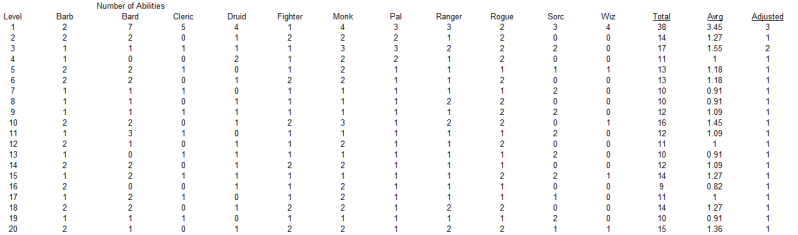
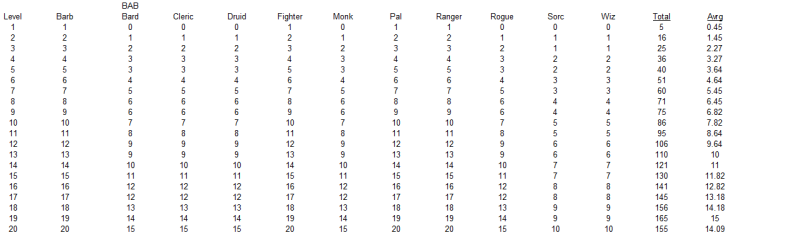
Analysis of Pathfinder Character Class Statistics
So! When I was going over the info for the “Low Fantasy” setting of Pathfinder's single customizable character class concept I did some analysis of what appeared in the classes progression wise.
These are just sheer numbers and it should be noted that a lot of this is my own chicken-scratch in a excel-like program. (Open Office's “Calc”) Some of the data recorded is totally useless but useless data sometimes stimulates my brain when I'm brainstorming.


These are just sheer numbers and it should be noted that a lot of this is my own chicken-scratch in a excel-like program. (Open Office's “Calc”) Some of the data recorded is totally useless but useless data sometimes stimulates my brain when I'm brainstorming.

Game with Meaning- Nobyl'
It's always been my belief that meaning comes from three things. Immersion, emotional attachment, and story. The three elements are quite interconnected so to define them could help. A player needs to be immersed in the story, weaving narrative into exposition so that game-play doesn't get in the way of a players personal connection to the story. Players need to develop an emotional attachment to the elements involved in the plots. In this regard the farther elements from the narrative get away from things they can personally relate to the less emotionally connected they are. (Players are more likely to connect to the plight of a puppy then to the plight of Slab Bulkhead the space marine from Mars) The narrative or story is the unifying thread that runs between the two- it is rather hard to create an earnest emotional connection or retain a high degree of player-immersion without a narrative. There is “Jenga” style personal connection to something YOU made, but a game concept that relays on that alone will be on wobbly feet indeed. It is with this in mind that I put forth the following game concept.
A narrative driven story that revolves around a member of a military reconnaissance unit during April 1986. Due to the rise of Mikhail Gorbachev in Russia and because of based on bad intelligence as to the exact nature of the United States sends in a recon unit to gather intelligence on a power plant in Prypiat, Ukraine. The player makes user-generated characters to fill out an Airborne United States Army Special Forces unit that the player brings up from basic training to their special ops training, all the way to their first real mission in Prypiat. I chose to employ user-generated content because when someone MAKES something it becomes a good deal more relatable. It should also be noted that user-generated content is a double edged sword. A player's initially reaction is to put whoever they may into a frilly pink dress, give them a mustache and a 5 o'clock shadow. This game would give them a LIMITED amount of control (height, weight, facial elements, eye color, voice style, hair color, hair style, names from a list). Each character “spot” would have a background narrative explained via dialogue during the narrative. One might be a hick farm boy from the south while another might be a rich-boy gamer from the north who wants to act out his violent fantasies for real. Each spot would be tailor made to be relatable to a major demographic in the United States.
The characters eventually make it to an air-drop in Prypiat where they have to establish a observational perimeter around the power plant and gather as much intelligence as possible. (By “looking” at various targets) It should be noted that players are given a gun and showed how to use it, as well as a side arm, combat knife, and hand to hand but they only have to fire it once or twice. This is a narrative driven story rather than a combat driven one.
The real emotional part of the story is the characters are actually observing Chernobyl Nuclear Power Plant when it goes off. They must watch as the citizens of Pripyat die slowly without giving away their cover. The US government refuses to pick them up- they are a covert operation and they can't just swoop in while the world's eyes are on them. You must also deal with the traumatic death of your squad mates. To make the story more immersive the game never out and out says “ Chernobyl” until it blows. It just refers to it as “the Pripyat Power Plant” and makes little mention of it's nuclear properties. This is so the players don't immediately make the connection.
Near the end of the game the player, now the only surviving member of the squad, decides to break his cover and attempt to save as many people from the spreading nuclear cloud as possible. (The Russians where VERY slow in alerting them to the real nature of the disaster and as a result. Waiting until 2p.m. on 27 April to really get started) The game ends with the player's character running out into the streets shooting off his gun trying to get people to flee- shouting out a warning before finally succumbing to his radiation exposure. The music plays him out on the Ballard of the Green Berets.
The goal of this game is not only to use the close personal connections for players, but also to educate the world on the shortcomings of the Soviet government in handling this accident. It would be as historically accurate as possible.
A narrative driven story that revolves around a member of a military reconnaissance unit during April 1986. Due to the rise of Mikhail Gorbachev in Russia and because of based on bad intelligence as to the exact nature of the United States sends in a recon unit to gather intelligence on a power plant in Prypiat, Ukraine. The player makes user-generated characters to fill out an Airborne United States Army Special Forces unit that the player brings up from basic training to their special ops training, all the way to their first real mission in Prypiat. I chose to employ user-generated content because when someone MAKES something it becomes a good deal more relatable. It should also be noted that user-generated content is a double edged sword. A player's initially reaction is to put whoever they may into a frilly pink dress, give them a mustache and a 5 o'clock shadow. This game would give them a LIMITED amount of control (height, weight, facial elements, eye color, voice style, hair color, hair style, names from a list). Each character “spot” would have a background narrative explained via dialogue during the narrative. One might be a hick farm boy from the south while another might be a rich-boy gamer from the north who wants to act out his violent fantasies for real. Each spot would be tailor made to be relatable to a major demographic in the United States.
The characters eventually make it to an air-drop in Prypiat where they have to establish a observational perimeter around the power plant and gather as much intelligence as possible. (By “looking” at various targets) It should be noted that players are given a gun and showed how to use it, as well as a side arm, combat knife, and hand to hand but they only have to fire it once or twice. This is a narrative driven story rather than a combat driven one.
The real emotional part of the story is the characters are actually observing Chernobyl Nuclear Power Plant when it goes off. They must watch as the citizens of Pripyat die slowly without giving away their cover. The US government refuses to pick them up- they are a covert operation and they can't just swoop in while the world's eyes are on them. You must also deal with the traumatic death of your squad mates. To make the story more immersive the game never out and out says “ Chernobyl” until it blows. It just refers to it as “the Pripyat Power Plant” and makes little mention of it's nuclear properties. This is so the players don't immediately make the connection.
Near the end of the game the player, now the only surviving member of the squad, decides to break his cover and attempt to save as many people from the spreading nuclear cloud as possible. (The Russians where VERY slow in alerting them to the real nature of the disaster and as a result. Waiting until 2p.m. on 27 April to really get started) The game ends with the player's character running out into the streets shooting off his gun trying to get people to flee- shouting out a warning before finally succumbing to his radiation exposure. The music plays him out on the Ballard of the Green Berets.
The goal of this game is not only to use the close personal connections for players, but also to educate the world on the shortcomings of the Soviet government in handling this accident. It would be as historically accurate as possible.
Thursday, April 8, 2010
Low Fantasy d20 System (Pathfinder Campaign Setting Mechanics)
Low Fantasy d20 Setting
By Scott Gladstein
Copyright 2009 under the OGL
Basics
Characters have “1 customizable character class”
You are a human. (Bonuses included in character creation)
Blessed vs Unblessed
Characters in this world are either protected by the gods or not. By default every character is “blessed”. An Unblessed in like an unbaptized baby. They do not have the protection of the gods and as such may never benefit from any divine spell. (However- they may be harmed by them) Characters may chose to plan an “Unblessed” character if they like. Unblessed occasionally gain powers like that of the gods themselves (traditionally it is called “magic”) though generally it is much weaker and much more limited in it's scope. Most civilized characters are blessed at birth via a simple ceremony administered by a local clergymen. Some of the fringe communities will use ancient rituals or other manors of contacting the gods but the result is the same. Most of the time it is required by law that all become blessed. A character must be blessed by the age of 5 or they will never be able to.
Those who are outside the graces of the gods often time have some sort of physical mark like a distinctly shaped birthmark or some minor benign deformity that will identify them. They tend to suffer “bad luck” quite often (good luck is thought to be brought on by the gods). They are generally from one of the magical covens or somehow slipped threw the cracks. It is rumored by heretics that the gods themselves where at one point “Unblessed” and that they only keep others blessed to suppress the natural potential of man to become god.
More often than not, sentient non humanoids are Unblessed. The slow corruption of their soul tends to bring out the worst in them and if steps are not taken they may devolve into nothing more than feral monstrosities.
A player must decide if they are blessed or Unblessed at character creation. They can not be switched at any point (unless by magical means).
Ability Score
Classic generating of ability scores. (3d6 six times and apply to whatever the ability score you wish. 8 or lower may be re-rolled)
+ 2 to a single ability score.
Medium size
30 ft base speed
Bonus feat (1 extra feat at first level)
Start with Common. May take any beyond that after.
Class Skills
Select 12 Class Skills
Hit Dice
d8
Skill Ranks Per Level
4
Weapon & Armor Proficiency
All Simple & Martial Weapons
Light Armor
Shields (except tower shields)
| Level | BAB | Fort Save | Ref Save | Will Save | Feats |
| 1 | 0 | 2 | 0 | 0 | 3 |
| 2 | 1 | 3 | 0 | 0 | 3 |
| 3 | 2 | 3 | 1 | 1 | 2 |
| 4 | 3 | 4 | 1 | 1 | 2 |
| 5 | 3 | 4 | 1 | 1 | 2 |
| 6 | 4 | 5 | 2 | 2 | 2 |
| 7 | 5 | 5 | 2 | 2 | 2 |
| 8 | 6 | 6 | 2 | 2 | 2 |
| 9 | 6 | 6 | 3 | 3 | 2 |
| 10 | 7 | 7 | 3 | 3 | 3 |
| 11 | 8 | 7 | 3 | 3 | 2 |
| 12 | 9 | 8 | 4 | 4 | 2 |
| 13 | 9 | 8 | 4 | 4 | 2 |
| 14 | 10 | 9 | 4 | 4 | 3 |
| 15 | 11 | 9 | 5 | 5 | 2 |
| 16 | 12 | 10 | 5 | 5 | 2 |
| 17 | 12 | 10 | 5 | 5 | 2 |
| 18 | 13 | 11 | 6 | 6 | 3 |
| 19 | 14 | 11 | 6 | 6 | 2 |
| 20 | 15 | 12 | 6 | 6 | 3 |
New Feats
Battle Rage (Weakened Barbarian Rage)
Prerequisite: +5 BAB
An seasoned adventurer can throw himself into a frenzy, calling upon inner reserves of strength and ferocity, granting him additional combat prowess. An adventurer can rage for a number of rounds per day equal to 4 + his Constitution modifier. Temporary increases to Constitution, such as those gained from rage and spells like bear’s endurance, do not increase the total number of rounds that an Adventurer can rage per day. An Adventurer can enter rage as a free action. The total number of rounds of rage per day is renewed after resting for 8 hours, although these hours do not need to be consecutive.
While in rage, an adventurer gains a +2 morale bonus to his Strength and Constitution, as well as a +1 morale bonus on Will saves. In addition, he takes a –2 penalty to Armor Class. The increase to Constitution grants the adventurer 2 hit points per Hit Dice, but these disappear when the rage ends and are not lost first like temporary hit points. While in rage, an adventurer cannot use any Charisma-, Dexterity-, or Intelligence-based skills (except Acrobatics, Fly, Intimidate, and Ride) or any ability
that requires patience or concentration. An adventurer can end his rage as a free action and is fatigued after rage for a number of rounds equal to 2 times the number of rounds spent in the rage. An adventurer cannot enter a new rage while fatigued or exhausted but can otherwise enter rage multiple times during a single encounter or combat. If an adventurer falls unconscious, his rage immediately ends, placing his in peril of death.
God's Watchful Eye (Uncanny Dodge)
Prerequisite: Blessed, Dodge
At 2nd level, a adventurer gains the ability to react to danger before his senses would normally allow him to do so by the grace of the gods. He cannot be caught flat-footed, even if the attacker is invisible. He still loses his Dexterity bonus to AC if immobilized. A adventurer with this ability can still lose his Dexterity bonus to AC if an opponent successfully uses the feint action against him.
Well Versed (Weakened Bardic Knowledge)
Prerequisite: Wisdom 18
This particularly wise adds half his class level (minimum 1) to all Knowledge skill checks and may make all Knowledge skill checks untrained. If he is not trained in it he receives a -5 to his roll.
Armor Training
Prerequisite: Proficient in heavy armor
This adventurer has learns to be more maneuverable while wearing armor. Whenever he is wearing armor, he reduces the armor check penalty by 1 (to a minimum of 0) and increases the maximum Dexterity bonus allowed by his armor by 1.
Advanced Armor Training
Prerequisite: Armor Training
This adventurer has learns to be more maneuverable while wearing armor. Whenever he is wearing armor, he reduces the armor check penalty by 2 (to a minimum of 0) and increases the maximum Dexterity bonus allowed by his armor by 2.
Armor of Faith
Prerequisite: Blessed, 3rd Level
Faith is a powerful ally and when one surrenders themselves to the protection of the gods they are rewarded. When unarmored and unencumbered, this character adds his Wisdom bonus (if any) to his AC and his CMD. These bonuses to AC apply even against touch attacks or when the monk is f lat-footed. He loses these bonuses when he is immobilized or helpless, when he wears any armor, when he carries a shield, or when he carries a medium or heavy load. Crossing the gods may remove your ability to do this.
Evasion
Prerequisite: Dodge
An adventurer who is particularly agile can avoid damage from many area-effect attacks. If an adventurer makes a successful Reflex saving throw against an attack that normally deals half damage on a successful save, he instead takes no damage. Evasion can be used only if an adventurer is wearing light armor or no armor. A helpless character does not gain the benefit of this feat.
Confidence
Prerequisite: Charisma 18
Some men where made to be leaders and carry on the good fight! Each ally within 10 feet of him gains a +4 morale bonus on saving throws against fear effects. This ability functions only while the character is conscious, not if he is unconscious or dead.
Smite Unblessed
Prerequisite: Blessed, 5th Level
An adventurer can call out to the powers of the gods to aid her in her struggle against those who would disdain the god. As a swift action, one per day the adventurer chooses one target within sight to smite. If this target is Unblessed, the adventurer adds her Charisma bonus (if any) to her attack rolls made against this target. If the target of smite evil is an outsider with the evil subtype, an evil-aligned dragon, or an undead creature, the bonus to damage increases to 2 points of damage per character level the adventurer possesses. Regardless of the target, smite attacks automatically bypass any DR the creature might possess. If the adventurer targets a creature that is not Unblessed, the smite is wasted with no effect. The smite effect remains until the target of the smite is dead or the next time the adventurer rests and regains her uses of this feat. Taking this additional times grants additional uses per day. Crossing the gods may remove your ability to do this.
Favored Enemy
Prerequisite: None
An adventurer selects a creature type from the favored enemies table. He gains a +2 bonus on Bluff, Knowledge, Perception, Sense Motive, and Survival checks against creatures of his selected type. Likewise, he gets a +2 bonus on weapon attack and damage rolls against them. An adventurer may make Knowledge skill checks untrained when attempting to identify these creatures. Taking this additional times
Favored Enemies:
Type (Subtype)
Aberration
Humanoid (other subtype)
Animal
Magical beast
Construct
Monstrous humanoid
Dragon
Ooze
Fey
Outsider (air)
Unblessed*
Plant
Undead
Vermin
*Must be Blessed to do this.
Track
Prerequisite: None
This character is well versed in tracking. He adds half his level (minimum 1) to Survival skill checks made to follow or identify tracks.
Homeland
Prerequisite: 3rd Level
A character may select a type of terrain from the Favored Terrains table as his homeland. The ranger gains a +2 bonus on initiative checks and Knowledge (geography), Perception, Stealth, and Survival skill checks when he is in this terrain.
Favored Terrains:
Cold (ice, glaciers, snow, and tundra)
Desert (sand and wastelands)
Forest (coniferous and deciduous)
Jungle
Mountain (including hills)
Plains
Planes (pick one, other than Material Plane)
Swamp
Underground (caves and dungeons)
Urban (buildings, streets, and sewers)
Water (above and below the surface)
Hunter's Stride
Prerequisite: Dexterity 13, Homeland
An adventurer is particularly adept at moving threw nature without disturbing it. He may move through any sort of undergrowth (such as natural thorns, briars, overgrown areas, and similar terrain) that he has taken the “Homeland” feat in at his normal speed and without taking damage or suffering any other impairment. Thorns, briars, and overgrown areas that have been magically manipulated to impede motion, however, still affect him. In addition this character leaves no trail in natural surroundings and cannot be tracked. He may choose to leave a trail if so desired.
Swift Tracker
Prerequisite: Hunter's Stride
An trained adventurer can move at his normal speed while using Survival to follow tracks without taking the normal –5 penalty. He takes only a –10 penalty (instead of the normal –20) when moving at
up to twice normal speed while tracking on his Homeland.
Hide in Plain Sight
Prerequisite: 10th Level, Homeland
While in his Homeland, an adventurer can use the Stealth skill even while being observed.
Sneak Attack
Prerequisite: 3rd Level
If an adventurer can catch an opponent when he is unable to defend himself effectively from her attack, she can strike a vital spot for extra damage. The adventurer’s attack deals extra damage anytime her target would be denied a Dexterity bonus to AC (whether the target actually has a Dexterity bonus or not), or when the rogue flanks her target. This extra damage is 1d6. Should the adventurer score a critical hit with a sneak attack, this extra damage is not multiplied. Ranged attacks can count as sneak attacks only if the target is within 30 feet. With a weapon that deals nonlethal damage (like a sap, whip, or an unarmed strike), an adventurer can make a sneak attack that deals nonlethal damage instead of lethal damage. She cannot use a weapon that deals lethal damage to deal nonlethal damage in a sneak attack, not even with the usual –4 penalty. The adventurer must be able to see the target well enough to pick out a vital spot and must be able to reach such a spot. A adventurer cannot sneak attack while striking a creature with concealment.
Improved Sneak Attack
Prerequisite: 5rd Level, Sneak Attack
Damage from your Sneak Attack is improved to 2d6
Greater Sneak Attack
Prerequisite: 7th Level, Improved Sneak Attack
Damage from your Sneak Attack is improved to 3d6
Assassin's Strike
Prerequisite: 10th Level, Greater Sneak Attack
Damage from your Sneak Attack is improved to 5d6
God's Warning
Prerequisite: Blessed
A adventurer adds 1/2 her level to Perception skill checks made to locate traps and to Disable Device skill checks (minimum +1). Crossing the gods may remove your ability to do this.
Well Balanced
Prerequisite: Dexterity 13
This ability allows an adventurer to move along narrow surfaces at full speed using the Acrobatics skill without penalty. In addition, an adventurer with this talent is not flat-footed when using Acrobatics to move along narrow surfaces.
Nimble Fingers
Prerequisite: Dexterity 13
It takes a skilled adventurer half the normal amount of time to disable a trap using the Disable Device skill (minimum 1 round) if they have this feat.
God's Salvation
Prerequisite: Blessed, Wisdom 13
Once per day, an adventurer with this ability can gain a number of temporary hit points equal to her character level. Activating this ability is an immediate action that can only be performed when she is brought to below 0 hit points. This ability can be used to prevent her from dying. These temporary hit points last for 1 minute. If the adventurer's hit points drop below 0 due to the loss of these temporary hit points, she falls unconscious and is dying as normal.
Fast Acting
Prerequisite: Improved Initiate
During the surprise round, opponents are always considered f lat-footed to a rogue with this ability, even if they have already acted.
Cantrips
Prerequisite: Unblessed
This adventurer may learn cantrips, or 0-level spells. These spells are cast like any other spell, but they do not consume any slots and may be used again.
1st Circle
Prerequisite: Unblessed
This adventurer may select one 1st level spell to cast a number of times per day equal to his character level. Taking this feat additional times will grant you the use of a different 1st level spell.
2nd Circle
Prerequisite: Unblessed , 3rd Level
This adventurer may select one 2nd level spell to cast a number of times per day equal to his character level. Taking this feat additional times will grant you the use of a different 2nd level spell.
3rd Circle
Prerequisite: Unblessed, 6th Level
This adventurer may select one 3rd level spell to cast a number of times per day equal to his character level. Taking this feat additional times will grant you the use of a different 3rd level spell.
4th Circle
Prerequisite: Unblessed, 9th Level
This adventurer may select one 4th level spell to cast a number of times per day equal to his character level. Taking this feat additional times will grant you the use of a different 4th level spell.
5th Circle
Prerequisite: Unblessed, 12th Level
This adventurer may select one 5th level spell to cast a number of times per day equal to his character level. Taking this feat additional times will grant you the use of a different 5ht level spell.
6th Circle
Prerequisite: Unblessed, 15th Level
This adventurer may select one 6th level spell to cast a number of times per day equal to his character level. Taking this feat additional times will grant you the use of a different 6th level spell.
7th Circle
Prerequisite: Unblessed, 18th Level
This adventurer may select one 7th level spell to cast a number of times per day equal to his character level. Taking this feat additional times will grant you the use of a different 7th level spell.
8th Circle (Godhood)
Prerequisite: Unblessed, 20th Level
This adventurer may select one 8th level spell to cast a number of times per day equal to his character level. Taking this feat additional times will grant you the use of a different 8th level spell.
Devotions
Prerequisite: Blessed, 5th Level
This adventurer may learn cantrips, or 0-level cleric spells . These spells are cast like any other spell, but they do not consume any slots and may be used again.
Clerical Spell
Prerequisite: Blessed, 5th Level, Devotions
This adventurer may select one 1st level cleric spell to cast a number of times per day equal to his character level. Taking this feat additional times will grant you the use of a different 1st level spell.
Priest Spell
Prerequisite: Blessed, 10th Level, Clerical Spell
This adventurer may select one 2nd level cleric spell to cast a number of times per day equal to his character level. Taking this feat additional times will grant you the use of a different 2nd level spell.
High Priest Spell
Prerequisite: Blessed, 15th Level, Clerical Spell
This adventurer may select one 3rd level cleric spell to cast a number of times per day equal to his character level. Taking this feat additional times will grant you the use of a different 3rd level spell.
Unblessed Spellcasting
The Unblessed cast arcane spells, but they do not use spellbooks or prepare spells. Feats limit the number of spells she can cast (see these “Circle” feats). An Unblessed must have a Charisma score of at least 10 + the spell’s level to cast the spell. (Beware when taking feats!)
Each day Unblessed must focus their minds on the task of casting their spells. An Unblessed needs 8 hours of rest, after which she spends 15 minutes re-centering herself. During this period, the Unblessed refocuses her soul and wards off the creeping grasp of corruption and this allows her to cast her daily allotment of spells. Without such a period to refresh herself, the character does not regain the use of her spells he used up the day before and may shift one toward a chaotic and evil alignment if three days they miss this small ritual.
Spells
0-Level Unblessed Spells
Detect Magic
Know Direction
Message
Create Water
Detect Poison
Purify Food and Drink
1st-Level Unblessed Spells
Alarm
Charm Person
Comprehend Language
Cure Light Wounds
Detect Unblessed*'
Calm Animal
Charm Animal
Detect Animal or Plants
Speak with Animal
Delay Poison
Pass Without Trace
2nd-Level Unblessed Spells
Alter Self
Blindness/Deafness
Cure Moderate Wounds
Darkness
Detect Thoughts
Invisibility
Locate Object
Suggestion
Scare
Tongues
Augury
Find Traps
Silence
Command Plants
3rd-Level Unblessed Spells
Charm Monster
Clairauudience/Clairvoyance
Daylight
Dispel Magic
Invisibility Sphere
Scrying
See Invisibility
Obscure Object
Remove Disease
Speak with Dead
Water Walk
Lesser Geas
Dominate Animal
Plant Growth
Speak with Plants
Darkvision
4th-Level Unblessed Spells
Break Enchantment
Cure Critical Wounds
Detect Scrying
Invisibility, Greater
Legend Lore
Locate Creature
Modify Memory
Zone of Silence
Discern Lie
Divination
Sending
True Seeing
Neutralize Poison
Commune with Nature
Nondetection
5th-Level Unblessed Spells
Cure Light Wounds, Mass
Dispel Magic, Greater
Dream
False Vision
Seeming
Suggestion, Mass
Unblessed*
Geas/Quest
6th-Level Unblessed Spells
Cure Moderate Wounds, Mass
Find the Path
Scrying, Greater
Create Undead
Heal
Contact Other Plane (God's Plane Only)
Instant Summons
7th-Level Unblessed Spells
Control Weather
Reincarnate
Teleport
Discern Location
Foresight
Sympathy
8th-Level Unblessed Spells
Wish
Time Stop
Holy Aura
Reverse Gravity
Cure Critical Wounds, Mass
0-Level Cleric Spells
Create Water
Detect Magic
Detect Poison
Light
Purify Food and Drink
Stabilize
Blessing Ritual*
1st-Level Cleric Spells
Cure Light Wounds
Detect Unblessed*
Endure Elements
Hide From Undead
Hide From Unblessed*
Weapon of the Gods* (Magic Weapon)
Protection from Unblessed*
Remove Fear
Sanctuary
Shield of Faith
2nd-Level Cleric Spells
Augury
Atonement
Commune
Prayer
Divination
Remove Curse
3rd Level Cleric Spells
Hallow
Forbiddance
Setting Only Spells
Protection from Unblessed
Casting Time 1 standard action
Components V, S, M/DF
Range touch
Target creature touched
Duration 1 min./level (D)
Saving Throw Will negates (harmless); Spell Resistance no; see text
This spell wards a creature from attacks by Unblessed creatures, from mental control, and from summoned creatures. It creates a magical barrier around the subject at a distance of 1 foot. The barrier moves with the subject and has three major effects.
First, the subject gains a +2 deflection bonus to AC and a +2 resistance bonus on saves. Both these bonuses apply against attacks made or effects created by Unblessed creatures. Second, the subject immediately receives another saving throw (if one was allowed to begin with) against any spells or effects that possess or exercise mental control over the creature (including enchantment [charm] effects and enchantment [compulsion] effects). This saving throw is made with a +2 morale bonus, using the same DC as the original effect. If successful, such effects are suppressed for the duration of this spell. The effects resume when the duration of this spell expires.
While under the effects of this spell, the target is immune to any new attempts to possess or exercise mental control over the target. This spell does not expel a controlling life force (such as a ghost or spellcaster using magic jar), but it does prevent them from controlling the target. This second effect only functions against spells and effects created by Unblessed creatures or objects, subject to GM discretion.
Third, the spell prevents bodily contact by Unblessed summoned creatures. This causes the natural weapon attacks of such creatures to fail and the creatures to recoil if such attacks require touching the warded creature. Summoned creatures that are Blessed are immune to this effect. The protection against contact by summoned creatures ends if the warded creature makes an attack against or tries to force the barrier against the blocked creature. Spell resistance can allow a creature to overcome this protection and touch the warded creature.
Hide From Unblessed
Casting Time 1 standard action
Components V, S, DF
Range touch
Targets one touched creature/level
Duration 10 min./level (D)
Saving Throw Will negates (harmless); see text; Spell Resistance yes
An Unblessed creature cannot see, hear, or smell creatures warded by this spell. Even extraordinary or supernatural sensory capabilities, such as blindsense, blindsight, scent, and tremorsense, cannot detect or locate warded creatures. Nonintelligent Unblessed creatures are automatically affected and act as though the warded creatures are not there. An intelligent Unblessed creature gets a single Will saving throw. If it fails, the subject can’t see any of the warded creatures. If it has reason to believe unseen opponents are present, however, it can attempt to find or strike them. If a warded creature attempts to make any hostile actions against the Unblessed (even with a spell), the spell ends for all recipients.
Detect Unblessed
Casting Time 1 standard action
Components V, S, M/DF (earth from a grave)
Range 60 ft.
Area cone-shaped emanation
Duration concentration, up to 1 minute/ level (D)
Saving Throw none; Spell Resistance no
You can sense the presence of an Unblessed. The amount of information revealed depends on how long you study a particular area or subject.
1st Round: Presence or an Unblessed
2nd Round: Number of Unblessed in the area and the power of the most powerful among them. If you are Blessed, and the strongest Unblessed’s power is overwhelming (see below), and the HD or level of the aura’s source is at least twice your character level, you are stunned for 1 round and the spell ends.
3rd Round: The power and location of each Unblessed. If an aura is outside your line of sight, then you discern its direction but not its exact location.
Aura Power: An Unblessed’s power depends on the type of evil creature or object that you’re detecting and its HD, caster level, or (in the case of a cleric) class level; see the table below. If an aura falls into more than one strength category, the spell indicates the stronger of the two.
Creature/Object None Faint Moderate Strong Overwhelming
Unblessed creature (HD) 5 or lower 5–10 11–25 26–50 51 or higher
Lingering Aura: An Unblessed's aura lingers after its original source dissipates (in the case of a spell) or is destroyed (in the case of a creature or magic item). If detect Unblessed is cast and directed at such a location, the spell indicates an aura strength of dim (even weaker than a faint aura). How long the aura lingers at this dim level depends on its original power:
Original Strength Duration of Lingering Aura
Faint 1d6 rounds
Moderate 1d6 minutes
Strong 1d6 × 10 minutes
Overwhelming 1d6 days
Each round, you can turn to detect evil in a new area. The spell
can penetrate barriers, but 1 foot of stone, 1 inch of common metal,
a thin sheet of lead, or 3 feet of wood or dirt blocks it.
Weapon of the Gods
As “Magic Weapon” only it is noted that this is a divine spell.
Saturday, March 6, 2010
Social Networking Site Use...

So! I was looking at some of my fav. demographic analysis sites for websites and I came across something really interesting. The image to the left is a graph of site traffic in the US. In green is MySpace, in blue is FaceBook, and red is Twitter. Sometime in February/March of '09 FaceBook kicked MySpaces ass, ending the slow decline. If we look at little Twitter we can see a giant spike in traffic at that time! Coincidence? :D
(Data from www.quantcast.com. Great site!)
Friday, February 26, 2010
Magic Casting Alternative (d20 system)
This variant adds a new ability score called (magical) "Aptitude" and divorces it from traditional physical attributes.
During character creation you roll 5d10. For every 1 you roll you get a +1 modifier to a your "Aptitude" score. (Your character is considered the lowest score that would grant that ability modifier) This represents a supernatural almost "destiny" element to your character.
Skill wise "Spellcraft" and "Use Magic Device" are no longer "Int"/"Cha" but "Apt" based.
Sorcerer Variant Class: Destined Sorcerer
Alignment: Any
Weapon & Armor Proficiency: As Sorcerer
Spells:
A Destined Sorcerer casts arcane spells drawn primarily from the sorcerer/wizard spell list presented in Chapter 10 (Pathfinder CRB). She can cast any spell she knows without preparing it ahead of time. To learn or cast a spell, a Destined Sorcerer must have a Aptitude score equal to at least 10 + the spell level. The Difficulty Class for a saving throw against a sorcerer’s spell is 10 + the spell level + the Destined Sorcerer’s Aptitude modifier. Like other spellcasters, a sorcerer can cast only a certain number of spells of each spell level per day. Her base daily spell allotment is given on Table 3–14 (Note: as sorcerer). In addition, she receives bonus spells per day if she has a high Aptitude score (see Table 1–3).
A Destined Sorcerer’s selection of spells is extremely limited. A Destined Sorcerer begins play knowing four 0-level spells and two 1st-level spells of her choice. At each new Destined Sorcerer level, she gains one or more new spells, as indicated on Table 3–15. (Unlike spells per day, the number of spells a Destined Sorcerer knows is not affected by her Aptitude score; the numbers on Table 3–15 are fixed.) These new spells can be common spells chosen from the sorcerer/wizard spell list, or they can be unusual spells that the sorcerer has gained some understanding of through study.
Upon reaching 4th level, and at every even-numbered Destined Sorcerer level after that (6th, 8th, and so on), a Destined Sorcerer can choose to learn a new spell in place of one she already knows. In effect, the Destined Sorcerer loses the old spell in exchange for the new one. The new spell’s level must be the same as that of the spell being exchanged. A Destined Sorcerer may swap only a single spell at any given level, and must choose whether or not to swap the spell at the same time that she gains new spells known for the level.
Unlike a wizard or a cleric, a Destined Sorcerer need not prepare her spells in advance. She can cast any spell she knows at any time, assuming she has not yet used up her spells per day for that spell level.
(Chart looks the same as Sorcerer)
Special
1st Level: Touch of Destiny, Cantrips, Eschew Materials
2nd Level:
3rd Level: Aura of Destiny (+1), "Alarm" (Spell)
4th Level:
5th Level: "Blur" (Spell)
6th Level:
7th Level: Destined Feat, "Protection from Energy" (Spell), Aura of Destiny (+2)
8th Level:
9th Level: It Was Meant To Be (Once per day), "Freedom of Movement" (Spell)
10th Level:
11th Level: "Break Enchantment" (Spell), Aura of Destiny (+3)
12th Level:
13th Level: Destined Feat, "Mislead" (Spell)
14th Level:
15th Level: Coming Destiny, "Spell Turning" (Spell), Aura of Destiny (+4)
16th Level:
17th Level: "Moment of Prescience" (Spell), It Was Meant To Be (Twice a per day)
18th Level:
19th Level: Destined Feat, "Foresight" (Spell), Aura of Destiny (+5)
20th Level: Destiny Realized
Cantrips: Destined Sorcerer learn a number of cantrips, or 0-level
spells, as noted on Table 3–15 under “Spells Known.” These
spells are cast like any other spell, but they do not consume
any slots and may be used again.
Eschew Materials: A Destined Sorcerer gains Eschew Materials as
a bonus feat at 1st level.
Touch of Destiny (Sp): At 1st level, you can touch a creature
as a standard action, giving it an insight bonus on attack
rolls, skill checks, ability checks, and saving throws equal
to 1/2 your Destined Sorcerer level (minimum 1) for 1 round. You can
use this ability a number of times per day equal to 3 + your
Aptitude modifier.
Destined Feats:
Arcane Strike, Diehard, Endurance, Leadership,
Lightning Reflexes, Maximize Spell,
Skill Focus (Use Magic Device), Skill Focus (Spellcraft)
Aura of Destiny (Su): Starting at 3rd level, you gain +1 natural armor
At 7th level and every four levels thereafter, this
bonus increases by +1, to a maximum of +5 at 19th level.
Coming Destiny (Su): At 15th level, your ultimate destiny
is drawing near. Once per day, when an attack or spell
that causes damage would result in your death, you may
attempt a DC 20 Aptitude roll. If successful, you are instead
reduced to –1 hit points and are automatically stabilized.
Destiny Realized (Su): At 20th level, your moment of
destiny is at hand. Any critical threats made against
you only confirm if the second roll results in a natural
20 on the die. Any critical threats you score with a spell
are automatically confirmed. Once per day, you can
automatically succeed at one caster level check made
to overcome spell resistance. You must use this ability
before making the roll.
During character creation you roll 5d10. For every 1 you roll you get a +1 modifier to a your "Aptitude" score. (Your character is considered the lowest score that would grant that ability modifier) This represents a supernatural almost "destiny" element to your character.
Skill wise "Spellcraft" and "Use Magic Device" are no longer "Int"/"Cha" but "Apt" based.
Sorcerer Variant Class: Destined Sorcerer
Alignment: Any
Weapon & Armor Proficiency: As Sorcerer
Spells:
A Destined Sorcerer casts arcane spells drawn primarily from the sorcerer/wizard spell list presented in Chapter 10 (Pathfinder CRB). She can cast any spell she knows without preparing it ahead of time. To learn or cast a spell, a Destined Sorcerer must have a Aptitude score equal to at least 10 + the spell level. The Difficulty Class for a saving throw against a sorcerer’s spell is 10 + the spell level + the Destined Sorcerer’s Aptitude modifier. Like other spellcasters, a sorcerer can cast only a certain number of spells of each spell level per day. Her base daily spell allotment is given on Table 3–14 (Note: as sorcerer). In addition, she receives bonus spells per day if she has a high Aptitude score (see Table 1–3).
A Destined Sorcerer’s selection of spells is extremely limited. A Destined Sorcerer begins play knowing four 0-level spells and two 1st-level spells of her choice. At each new Destined Sorcerer level, she gains one or more new spells, as indicated on Table 3–15. (Unlike spells per day, the number of spells a Destined Sorcerer knows is not affected by her Aptitude score; the numbers on Table 3–15 are fixed.) These new spells can be common spells chosen from the sorcerer/wizard spell list, or they can be unusual spells that the sorcerer has gained some understanding of through study.
Upon reaching 4th level, and at every even-numbered Destined Sorcerer level after that (6th, 8th, and so on), a Destined Sorcerer can choose to learn a new spell in place of one she already knows. In effect, the Destined Sorcerer loses the old spell in exchange for the new one. The new spell’s level must be the same as that of the spell being exchanged. A Destined Sorcerer may swap only a single spell at any given level, and must choose whether or not to swap the spell at the same time that she gains new spells known for the level.
Unlike a wizard or a cleric, a Destined Sorcerer need not prepare her spells in advance. She can cast any spell she knows at any time, assuming she has not yet used up her spells per day for that spell level.
(Chart looks the same as Sorcerer)
Special
1st Level: Touch of Destiny, Cantrips, Eschew Materials
2nd Level:
3rd Level: Aura of Destiny (+1), "Alarm" (Spell)
4th Level:
5th Level: "Blur" (Spell)
6th Level:
7th Level: Destined Feat, "Protection from Energy" (Spell), Aura of Destiny (+2)
8th Level:
9th Level: It Was Meant To Be (Once per day), "Freedom of Movement" (Spell)
10th Level:
11th Level: "Break Enchantment" (Spell), Aura of Destiny (+3)
12th Level:
13th Level: Destined Feat, "Mislead" (Spell)
14th Level:
15th Level: Coming Destiny, "Spell Turning" (Spell), Aura of Destiny (+4)
16th Level:
17th Level: "Moment of Prescience" (Spell), It Was Meant To Be (Twice a per day)
18th Level:
19th Level: Destined Feat, "Foresight" (Spell), Aura of Destiny (+5)
20th Level: Destiny Realized
Cantrips: Destined Sorcerer learn a number of cantrips, or 0-level
spells, as noted on Table 3–15 under “Spells Known.” These
spells are cast like any other spell, but they do not consume
any slots and may be used again.
Eschew Materials: A Destined Sorcerer gains Eschew Materials as
a bonus feat at 1st level.
Touch of Destiny (Sp): At 1st level, you can touch a creature
as a standard action, giving it an insight bonus on attack
rolls, skill checks, ability checks, and saving throws equal
to 1/2 your Destined Sorcerer level (minimum 1) for 1 round. You can
use this ability a number of times per day equal to 3 + your
Aptitude modifier.
Destined Feats:
Arcane Strike, Diehard, Endurance, Leadership,
Lightning Reflexes, Maximize Spell,
Skill Focus (Use Magic Device), Skill Focus (Spellcraft)
Aura of Destiny (Su): Starting at 3rd level, you gain +1 natural armor
At 7th level and every four levels thereafter, this
bonus increases by +1, to a maximum of +5 at 19th level.
Coming Destiny (Su): At 15th level, your ultimate destiny
is drawing near. Once per day, when an attack or spell
that causes damage would result in your death, you may
attempt a DC 20 Aptitude roll. If successful, you are instead
reduced to –1 hit points and are automatically stabilized.
Destiny Realized (Su): At 20th level, your moment of
destiny is at hand. Any critical threats made against
you only confirm if the second roll results in a natural
20 on the die. Any critical threats you score with a spell
are automatically confirmed. Once per day, you can
automatically succeed at one caster level check made
to overcome spell resistance. You must use this ability
before making the roll.
Subscribe to:
Posts (Atom)
