Tuesday, May 18, 2010

Full Metal Alchemist D20

Disclaimer: This belongs to the companies that hold their copyright. Unlike other things on this blog- this is not free for use. I was just seeing if I could design within the boundaries of a series. This is a work in progress.


Full Metal Alchemist D20


Races

Human (Amestris)

“Amestris is a unitary State, with a Parliamentary Republic type of Government. The Head of State is the Commander-in-Chief of the Army, titled as "Führer" (Daisoutou from the Japanese), who concentrates the ranks of President and Prime-Minister of the country. He also controls the Parliament.

The country is composed by several nations, quite diverse in culture and religion amongst themselves. The administrative regions of the country seem to reflect those differences. The country being divided in 5 provinces: South Area, West Area, North Area, East Area and Central Area”.

Racial Traits

+2 to one ability score

The people of Amestris as varied as they are numerous and it's rare to see any two with the same strengths or weaknesses.

Medium

Normal Speed

Bonus Feat Amestris humans gain one extra feat at 1st level to represent their diversity.

Greed Amestrians receive a +2 racial bonus on Appraise skill checks made to determine the price

of non-magical goods.

Languages Amestrians start play speaking Amestris one other language of their choice. Amestrians with high intelligence scores can chose any language they want. (except for secret languages such as Ancient Ishbalan)


Human (Ishval)

“The Ishbalans are a religious people, characterized by their brown skin and red eyes. The majority of their population were slaughtered by the State Military during the Ishbalan Civil War. The few survivors live as criminals and refugees in various slums across the country, usually leaping at the opportunity to fight against Amestrians.”

Racial Traits

+2 Constitution, +2 Wisdom, -2 Charisma

Ishbalans are a strong race with a strict adherence to the religious centers of their communities. They are generally wise beyond their years, though a stigma against them has put them at odds with the majority of the population in Amestris.

Hatred Ishbalans receive a +1 bonus on attack rolls against Amestrians due to special training against these hated foes.

Religious Ishbalans receive a +2 racial bonus on Religion skill checks made in relationship to their own religion and can make checks untrained in it.

Languages

Ishbalans start play speaking Amestris and Ishbalan. Ishbalans with high intelligence scores can chose from the following: Xing, Ancient Ishbalan, or Sign Language.


Human (Xing)

“Xing, a country far away from Amestris. Its people are Asian in appearance, and are split into fifty clans under the rule of a single emperor. The emperor has fathered a prince or princess for each of the fifty families.”

Racial Traits

+2 Dexterity, +2 Intelligence, -2 Constitution

Those from Xing tend to be well-educated and their slight stature allows them to employ much more nimble movements than those in Amestris.

Keen Senses Characters from Xing receive a +2 racial bonus on Perception skill checks.

Keen Senses Characters from Xing receive a +2 racial bonus on Perception skill checks.

Weapon Familiarity Characters from Xing are proficient with and treat any weapon with the word “Xing” in its name as a martial weapon.


Homunculi

“Homunculus (Latin for "Little Human", plural Homunculi) refers to the mythological concept of an artificially created human, presumably brought into existence by way of alchemy. Though a common concept, well known and understood by alchemists in Amestris, the idea of homunculi is regarded as no more than a farce or faraway fantasy as no individual or group of alchemists has come anywhere close to successfully creating such a being in officially recorded history. Even so, alchemists have been forbidden by the Amestrian government to attempt or research in the transmutation of humans and State Alchemists have such a restriction as part of their creed.”

Level Adjustment +4

Racial Traits

Construct

Alchemical Regeneration The philosopher stone at the heart of a Homunculi can regenerate wounds very quickly. So long as the stone is in it's chest it continually allows a Homunculi to cast “Alchemical Regeneration” at will as a standard action. In addition, a Homunculi is immune to bleed damage.


Base Classes

Alchemist

“An Alchemist is one of the many remarkable individuals capable of studying and practicing alchemy. As the craft of alchemy requires a full understanding of chemistry and ancient alchemical theory, alchemists are closer to scientists than magicians, but the ability to perform alchemy is also tied to an inherent talent for manipulating matter and energy so not all people can become competent alchemists merely by studying.


Though essentially scientists, alchemists' abilities are incredibly practical and can be applied to the simple enhancement of normal life in the form of quick, relatively effortless repair of objects that ordinarily take a good deal of time and energy to fix. As such, alchemists are revered as productive members of society and hold the concept of “Be Thou For The People” as their unofficial credo. This creed dictates that alchemists use their abilities for the good of the public rather than for personal gain or political reasons, a creed generally rejected by alchemists who opt for government licenses and funding as State Alchemists.


Despite their obligation to the people, alchemists are also careful to keep the secrets of their research out of the hands of the general public so as to prevent abuse of that knowledge and power by those with less-than-noble intentions. As such, alchemists generally keep their research notes coded so that only they - or other like-minded alchemical geniuses - may understand them.”

Alignment Any

Hit Die d6

Class Skills

The Alchemists class skills are:

Appraise (Int), Bluff (Cha), Craft (Int), Fly (Dex), Intimidate (Cha), Knowledge (Alchemy) (Int), Profession (Wis), Transmutation Circles (Int)

Skill Ranks per Level

2 + Int Modifier


Class Features

All of the following are class features of the Alchemist:

Weapon and Armor Proficiency Alchemists are proficient with all simple weapons. They are not proficient with any type of armor or shield. Armor interferes with a Alchemist's gestures, which can cause her transmutations with somatic components to fail (see Arcane Spells and Armor on page 83 of the Pathfinder Core Rulebook).

Alchemy An Alchemist casts transmutation spells drawn primarily from the Alchemist's spell list late in this document. They can use any spell they know without preparing it ahead of time. To

learn or cast a spell, an Alchemist must have a Intelligence score equal to at least 10 + the spell level. The Difficulty Class for a saving throw against a sorcerer’s spell is 10 + the spell level + the Alchemists' Intelligence modifier.

Due to the stress on their bodies, an Alchemist can cast only a certain number of spells of each spell level per day. Their base daily spell allotment is given below. In addition, they receive bonus spells per day if she has a high Intelligence score.

An Alchemist's selection of spells is extremely limited. An Alchemist begins play knowing four 0-level spells and two 1st-level spells of their choice. At each new Alchemist level, they gain one or more new spells, as indicated on the Table below. (Unlike spells per day, the number of spells an Alchemist

knows is not affected by her Intelligence score) These new spells can be common

spells chosen from the Alchemist's spell list, or they can be unusual spells that the Alchemist has gained some understanding of through study.

Unlike a other spell casting classes in some d20 games, an Alchemist need not prepare their spells in advance. They can cast any spell they knows at any time, assuming they have not yet used up their spells per day for that spell level.


Physical Enhancement (Su): You gain a +1 enhancement bonus to one physical ability score (Strength, Dexterity, or Constitution). This bonus increases by +1 for every five Alchemist levels you possess to a maximum of +5 at 20th level. At 20th level, this bonus applies to two physical ability scores of your choice.


Alchemical Adept (Ex) At 3rd level, you can apply any one metamagic feat you know to a spell you are about to cast without increasing the casting time. You must still expend a higher-level spell slot to cast this spell. You can use this ability once per day at 3rd level and one additional time per day for every four sorcerer levels you possess beyond 3rd, up to five times per day at 19th level. At 20th level, this ability is replaced by arcane apotheosis.


Alchemical Power (Ex) At 15th level, the DC for any Alchemical Spells you cast increases by +4. This bonus stacks with the bonus granted by Spell Focus.


The Truth (Ex) At 10th level, you've reached the zenith of your alchemical research and have come across a great truth. You can select one of the following:

The Gate

Having witnessed the Truth of the Gate though one fashion or another you are able to decode the information given to you there. This results in a +10 bonus to Transmutation Circles (Int) checks.


Soldier


Fighter

Combat Feat

Combat Feat

Combat Feat

Combat Feat

Combat Feat

Combat Feat

Combat Feat

Combat Feat

Combat Feat

Combat Feat


Homunculi Racial Class

(L5) Alchemical Regeneration 2d8

(L10) Alchemical Regeneration 3d8

(L15) Alchemical Regeneration 4d8

(L20) Alchemical Regeneration 5d8


Prestige Classes

State Alchemist

Flame Alchemist

Medical Alchemist

MarksmenLeader

Ninja


Spells

Alchemical Regeneration

School Alchemy (healing)

Casting Time 1 Standard Action

Components None

Range Touch

Target Living creature touched

Duration Instantaneous

Saving Throw Fortitude negates (harmless); Spell Resistance

yes (harmless)

The subject’s severed body members (fingers, toes, hands, feet, arms, legs, tails, or even head), broken bones, and ruined organs grow back. After the spell is cast, the physical regeneration is complete in 1 round. Regenerate also cures 1d8 points of damage + 1 point per caster level (maximum +35), rids the subject of exhaustion and fatigue, and eliminates all nonlethal damage the subject has taken. It has no effect on nonliving creatures (including undead).


Skills

Knowledge (Alchemy) (Int) [Use to be Arcana]

Transmutation Circles (Int) [Use to be Use Magic Device]


Tuesday, May 4, 2010

VBlog

I decided to start a video blog. It will cover a lot of things I do on this site. Hopefully I will reach a wider audience :D

http://www.youtube.com/user/oneyeartogo#p/a/u/0/4SNDUGyg9Mg

Monday, May 3, 2010

Steampunk LARP Concept

Steampunk LARP

Skills

Vitality 1* (You start with 1 hit point)

Vitality 2 (Your hit points increase to 2.)

Vitality 3 (Your hit points increase to 3.)

Vitality 4 (Your hit points increase to 4.)

Vitality 5 (Your hit points increase to 5.)

Pistol Proficiency [10 Second Reload.]

Revolver Proficiency [30 second reload after up to 6 shots]

Rifle Proficiency [20 Second Reload]

Blunderbuss Proficiency [30 second reload after 1 multi-shot of no more than 6 darts.]

Small Weapon Proficiency* (You must state if the weapon you are using is bladed or blunt when created.)

Bladed Weapon Proficiency

Blunt Weapon Proficiency

Great Weapon Proficiency (Required using two hands in order to deal damage. You must state if the weapon you are using is bladed or blunt when created.)

Light Armor Proficiency (Grants 1 armor to any limb it covers or the torso)

Medium Armor Proficiency (Grants 2 armor to any limb it covers or the torso)

Heavy Armor Proficiency (Grants 3 armor to any limb it covers or the torso)

Mechanized Armor Proficiency (Grants2 armor to any limb it covers or the torso but it can be upgraded… by SCIENCE!)

Shield Proficiency (Up to Kite Shield Size)

Tower Shield Proficiency (Up to tower shield sized)

Buckler Proficiency (Smaller than a pizza box)

Science! (This skill allows you to use various advanced pieces of technology. It is not specialized, but if you are trained it “Science!” you can at least glean some form of information on its design or make use of it in some limited fashion.)

Engineering (This skill allows you to use various advanced weaponry or at least identify how one WOULD use it.)

Repair (It takes 1 minuet of uninterrupted role-playing to recover 1 point of armor to one area. To repair a broken weapon it takes 5 minutes of roleplay.)

Upgrade: Armor Plating (You may increase the armor value of mechanized armor by 2. It counts as heavy armor for the purposes of negating bullet damage. You must purchase the necessary armor plates. This MUST be stylized on the armor.)

Upgrade: Mechanized Reloader (Once per day you may reload and fire your next shot as soon as you are physically able to. You must purchase the necessary mechanized reloader. This MUST be stylized on the armor.)

Upgrade: Chainsaw Edge (Any blows from a bladed weapon upgraded with this automatically deal 2 damage to armor. You must purchase the necessary mechanized chainsaw parts for the weapon. This MUST be stylized on the weapon. )

Upgrade: Pneumatic (Any blows from a blunt weapon upgraded with this automatically destroy a weapon once per day per time upgraded with this upgrade. You must call “Pneumatic !” when you’re using this technique. Missed swings to not expend this. You must purchase the necessary Pneumatic parts for the weapon. This MUST be stylized on the weapon. )

Upgrade: Anti-Artillery Plating (By adding a layer of tank plating to the front of a shield, it becomes sufficiently thick enough to ignore ALL bullet damage. If the shield is hit with a bullet, they do not take the 1 damage to the limb the shield is using. This must be stylized on the shield. It may not be added to a Buckler.)

Pseudoscience (This skill allows you to use various bizarre fringe technology or at least identify how one WOULD use it.)

Detect Paranormal (After one minuet of roleplaying setting up a pseudoscientific display you may call out “I detect all unnatural presence before me!”. This has various effects dependent on the unnatural element.)

Reverse Paranormal Influence (After one minuet of roleplaying enacting a pseudoscientific experiment you may call out “I expel all unnatural elements before me!”.)

Medical (This skill allows you to use various medical technology or at least identify how one WOULD use it.)

First Aid (By roleplaying 1 minuet of aid to a character at zero hit points you can restore them back to one.)

Medical Treatment (By roleplaying two minutes of aid to an injured character . (Note: not an unconscious character) you can restore one hit point to them.

Diagnosis (A character with this skill can diagnose what's wrong with another. They may whisper a question such as “are you poisoned?” and the character may respond in the same fashion to the best of their knowledge. This is out of game talk to represent the character in-game knowledge. It takes 30 second to diagnose but after those 30 seconds you may ask as many questions as you wish.)

Augmentation (This skill allows you to use various bio-technological components or at least identify how one WOULD use it.)

Embedded Automatic Defibrillator (When your heart stops a rather unpleasant jolt fries your ticker to attempt to keep it ticking again. As soon as you are reduced to zero hit points you must fall to the ground. After the one minuet of bleeding out expires you sit back up at one hit point… and in extreme pain. This can only occur once per event. This must be stylized as part of your costume. This requires the correct components to create. The surgery for this takes place between events.)

Mechanized Arm (One of your arms is no longer of flesh and blood. It is permanently grafted with a one handed melee weapon. It can’t be destroyed or detached. That limb automatically has 6 armor but when that armor is destroyed the limb is useless until repaired to at least 1 armor. This must be stylized as part of your costume. This requires the correct components to create. The surgery for this takes place between events.)

*You start with these skills.

Guns

Guns are approved by staff and are Nerf (or an equivalent brand. Homemade guns will be approved on a case by case basis). They MUST be stylized to fit the setting. You may use any gun so long as they fit the following criteria:

-It only fire 1 shot within the determined reload time. (except for the Blunderbuss)

-You must roleplay the reload time of your weapon, uninterrupted and unmoved. Any interruption (a blow or moving from your spot for example) causes you to have to restart the reload.

-Pistols & Revolvers must shoot no further than 10 feet on average.

-Rifles & Blunderbuss have no limit on range.

-A shot that hits a limb will result in reducing a person to 1 vitality and that limb is stunned.

-If heavy armor is hit it instantly reduces it to zero armor but the area it hit is still fine.

-A shot that hits the torso will result in an instant death.

-Guns may NEVER be used in melee in any capacity. Using it in melee WILL result in your instant death and repercussions from staff.

-Ammunition must be bought. You don’t need to use different darts each time- but you DO need to keep track of how much ammo you are using.

Weapons

Any melee weapon must be made according to our guidelines. (Boffer/Latex) This is a lightest touch system- ANY bodily contact will be sufficient to deal damage. Any blow from a weapon (regardless of weapon type) deals one point of damage. The head is NEVER a legal target. Contact with a weapon during a blow is sufficient to negate any damage.

Armor

Armor provides extra HP to the body-part it covers. (Left/Right Limbs and torso). Armor goes before any HP. After it is damaged- it takes the skill “repair” to restore it.

Shields

Shields block all incoming melee and bullet damage. In the case of bullets- it is assumed that the bullet still goes through the shield but because it goes through it the damage is not sufficient enough to kill the target. If a shield gets hit with a bullet- that limb takes 1 point of damage. Tower shields and shield upgraded with the Anti-Artillery upgrade are thick enough to ignore this damage.

Injury/Death

Each weapon blow is one damage. Each bullet shot to a limb reduces you to 1 hp and stuns your limb. A bullet shot to your torso instantly kills you. If you are reduced to 1 hp, any blow to a limb stuns it until you get 1 point of healing in any fashion. In order to die- the final blow must land on your torso.

After you are reduced to zero hit points by a blow to the torso means you are bleeding out. You are unconscious (aka: bleeding out) for 1 minute. If anyone starts to attempt to administer first aid this stops the timer and resets it while they are healing you. If they are interrupted you start to bleed out again. After one minute you make your way to the fate room and draw your card to see if you return back to life.

When you die, it is not the end. You go to the cast area and draw from the deck of fate. They will dictate what happens to your character. More often than not you will return to the land of the living by the

Plot

“I’ve seen some sick things kids. Some really sick things- but nothing as sick as you lot. The world’s going to hell and you’re profiteering from it? You all must have a screw loose or two to shack up on that heap like the “Heart-Warmer” with a person like Dr. Goodfellow. Into the fray he says! “For money! For love! For the sake of living he says!” Watch out for number one so you don’t step in number two is all I say! The Britannia Empire has a price on his head and if you step foot on his ship you do to!”

The world is at total war and you’ve shipped up with Dr. Goodfellow on his ship “The Heart-Warmer”. His crew of mercenaries gets contracts to attack other ships in a pirate-like fashion. They have no side except for those who pay them the most. Sometimes they are hired for other type of jobs. Most of the time their contracts are not made public as officially they have been declared war-criminals by both sides and hiring them would be an offence.

The Great Harvest God

A great, malicious, chaotic god of madness lies beyond the reaches of mortal perception. His influence on the world is profound despite the fact that he is currently not yet born. It is merely the fact that he WILL be born that influences the world. His impending coming adds an element of chaos to the world- making unnatural things occur. (This is basically the plot’s “A Wizard Did it”. It is reminiscent of our favorite Lovecraftian horror.)

Tuesday, April 27, 2010

Mass Combat Part 1

Squad Template
Squads represent rank and file of Small or Medium creatures that would not be particularly dangerous in small groups, but can be terrible foes when gathered in sufficient numbers. For game purposes a squad is defined as a single creature with a space of 30 feet—gigantic hordes are actually composed of dozens of squads in close proximity. A squad has a single pool of Hit Dice and hit points, a single initiative modifier, a single speed, and a single Armor Class. It makes saving throws as a single creature.
A squad of small creatures consists of approximately 15 non-flying creatures or 7 flying creatures. A squad of medium creatures consists of 30 non-flying creatures or 10 flying creatures. Squads of non-flying creatures include many more creatures than could normally fit in a 20-foot square based on their normal space, because creatures in a squad are locked in rank and file. They have no penalty due to this close quarters fighting because they are generally trained to fight shoulder to shoulder when moving or attacking. Larger squads are represented by multiples of single squads. A large squad is completely shapeable, though it usually remains contiguous.

Creating a Squad

"Squad" is an acquired template that can be added to any small or medium creature, magical beast, or undead. (referred to hereafter as the "base creature"). This creatures must have a sufficient intelligence modifier to benefit from military training (Undead are the exception).

A squad uses all the base creature’s statistics and special abilities except as noted here.

Size and Type: Size and type remain unchanged. Skill points and feats are recalculated based on Hit Dice. The base creature gains the squad subtype.

Hit Dice: A squad's Hit Dice are based on the size of the base creature and multiplied by the number of creatures in the squad. A creature with D8 Hit dice has 30 D8 HP (if the squad is comprised of medium non-flying creatures). You can simplify it by rolling a d8 once and multiplying the result.
A modifier of 1 Hit Die per point of Con over 10 is added after the base Hit Dice are multiplied.

Speed: Same as the base creature.

Armor Class: Same as the base creature.

Attack: A squad attacks as one cohesive creature. It receives a “Squad Size” bonus equivalent to the number of creatures remaining in the squad. (A squad of medium non-flying creatures has a +30). This bonus applies to the Squad’s Base Attack Bonus and strength score.

Full Attack: Same as attack.

Special Qualities: A squad retains all the special qualities of the base creature and those listed below.
Squad Traits: Every time a squad looses Hit Points equivalent to its hit dice it gets a -1 “Squad Size” bonus.
A squad takes half damage from single-target damage spells and double damage from area of effect damage spells. Other spells and effects that may disable, disband, or kill a single squad member will damage the squad equal to its Hit Dice (“killing one member”).
A swarm rendered unconscious by means of nonlethal damage becomes disorganized and dispersed, and does not reform until its hit points exceed its nonlethal damage.
Saves: Same as the base creature.

Abilities: Same as the base creature.

Skills: Same as the base creature.

Feats: Same as the base creature.

Environment: Same as the base creature.

Organization: Solitary, Division (5-20 Squads) or Army (50-100+ Squads)
Challenge Rating: Same as the base creature +10 (Design Note: Needs testing. This is a ballpark)
Treasure: Same as base creature.

Alignment: Same as the base creature.

Advancement: Same as the base creature.

Level Adjustment: --

Bird’s Eye View
Squads are generally meant to hit other squads. They will decimate the majority of player characters (dealing at least 30 damage per turn) unless the player characters are of sufficient level.

Leadership & Orders
A squad must make a successful “Leadership” check. If the squad does not have a leadership score they use their charisma score.
If the squad is at the command of some sort of leadership figure they use the Leadership score of the creature giving the commands in place of their own.
Giving an order is a full round action if it is from a creature outside of the squad. It is a free action if it comes from within the squad.

Orders
“Double Time!”
Leadership DC: 10
The squad has twice it’s movement speed this turn. They a flatfooted until the start of their next turn.

“Charge!”
Leadership DC: 15
The squad makes a charge attack.

“Overrun!”
Leadership DC: 20
The squad makes an overrun attack.

“Flank Attack!”
Leadership DC: 20
The squad deals an additional d10 sneak attack damage. This damage can be applied to other Squads.

“Regroup!”
Leadership DC: 30
On a successful Regroup check the squad gains hit points equal to their hit dice. This also restores a +1
This is a full round action. They a flatfooted until the start of their next turn.

Monday, April 12, 2010

Exposition, Narrative, Insane Clowns, and Daggers You Really Want

*Warning, this is something of a rant*


In my opinion gameplay shouldn't be complimented by roleplaying. It should be the other way around. Game mechanics should be designed around the narrative/roleplaying in the game.


One of my favorite experiences as a GM was actually running a relatively short-lived D&D 4th edition game with a few of my friends. There was a tale about an “emotional plane” (home-brewed stuff of course) colliding with our. One of the fights was against a “Insanity Elemental”. He had 3 little “invokers” which could activate an “insanity” effect on the players. I knew the players pretty well so I tossed out the rules for “insanity” from the PHB and went for something more abstract. If he successfully effected them with this spell-like ability they would become “insane”. An insane character got a save at the end of their turn (10+ ends) but one of their actions was controlled by the GM. (Movement, standard, free, ect) By describing the various things that MADE THEM INSANE I didn't even have to take the action for them by the end of the fight! For instance, the spell caster had a lava-lamp like thing apparently smothering him so the only obvious answer to his character was to magic-missile himself in the face to get it off. (his choice- not mine) Another one actually took off his armor and got naked due to the apparent seething flames belching forth from his armor. It was an example of rules almost coming about as a result of good roleplaying.

In that same campaign the players where effected by a “Lust Elemental” who compelled every member of the party to seek out “the dagger”. The players didn't know WHAT “the dagger” was but (as our mantra became that session) they “really wanted the dagger”. EVERY question about it ended with the line “...but/and you really want the dagger.”. Even when the players where doing something completely unrelated I would bug them for a moment and say something like:
“Hay Andrew“
“What?”
“Do YOU want the dagger?”
“Um.. I don't know? Do I?”
“Yes... you want the dagger”
“STILL”
“Yes.”
“Hay Alissa“
“O god...”
“Do YOU want the dagger?”
“*Sigh* Yes”
“That's right... you want the dagger”
This went on for the ENTIRE session, to the point where there was no need to use any in-game mechanics to FORCE them to roleplay a magical compulsion towards the dagger- they simply wanted the dagger. In the end it was actually another lust elemental who had turned herself into a dagger. I didn't even bother to make rules for the magical compulsion- the players just really wanted the dagger. It was an interesting experience, the roleplaying guided the group to almost make rules for themselves. I guess if you paint a vivid enough picture or make something EXCESSIVLY reprehensible then you can guide a game simply by roleplay rather than by clunky rules. Do I think this would work for a group of inexperienced roleplayers? No. The people I had with me where all excellent and where doing this out of sheer enjoyment- but that's how pen and paper games should be right? Just sitting around laughing you ass off while playing a compelling game. To this day when I talk to the players they still something ask “By the way, do I want the dagger?” and all I can do is smile and say “Yes! You REALLY want the dagger.”

Pathfinder Extra

I had an entire campaign written up for a group that never ran so I'll toss it up on the site. I know I've been going on a lot about Pathfinder lately but I've taken a shine to it. It's D&D 3.5 fixed (more or less), kinda like what Hackmaster did to AD&D. I've gotta say- it's pretty fun. I like it a bit more than 3.5 and certifiably bad ass when compared to 4th edition's MMO-ness. (Sure it's quicker... but I'm a fan of rules upon rules upon rules :D I'm a wargammer damn it! Don't screw with the good parts!) What follows is a kinda smattering of the interesting bits from the campaign setting:


Racial Lore: Vættir (Vet-te-ear)


Elves and Dwarves are of the same race (collectively called “Vættir”). Their origins are unclear; however they seem to have been influenced a great deal by magic at some point in their evolution. All Elves are female (in fact in Vættir “Elf” means “Female” generally) and all Dwarves are male. This is something of an extreme example of sexual dimorphism. They generally live in separate communities and more often than not- dislike each other a great deal. (Courtship is extremely difficult…) Vættir never are subject to death though aging- though their bodies do eventually weaken and they become more accident prone. In regards to mixed breeding with other races, the daughter of an elf is always a full blooded elf. A half-elf is always male (and normally laughed very hard at by Dwarves). The son of a Dwarf is always a Dwarf. The daughter of a dwarf is a half dwarf (Counted as “Halfling” but has the familiarity with the weapon family “Dwarf” instead of Halfling). It should be noted that half-breeds are sterile.


Homebrewed Special Rules:
“Only wicked shall perish.”
Those who revere the Divine Father (or whatever deity you are interested in) are subject to his protection. In his eyes, those who are wicked (even temporarily) are undeserving of his graces. Those who uphold his tenets and act in the name of justice should never fear the blade of the wicked. To represent this characters that follow the Divine Father stabilize on charisma roll of 15+ if they are of the good alignment. If they are neutral they use the normal rules for going below zero. Players who worship the Divine Father who fall to the evil alignment instantly die when they reach zero hit points. Following another deity shifts you to evil alignment to evil (as you have betrayed your deity). The Divine Father objects to his people using any other deity’s power. Willfully seeking the blessing of another deity shifts your alignment towards Evil. To the Divine Father, Magic is a sick blight on the planet- tainting pure ideals with it’s influence. Using a magic automatically shifts your alignment towards Evil.

“All things are temporary.”
In this setting alignment is a shifting aspect of one’s personality. An evil act could easily drop a character from a good alignment to a neutral or possibly evil alignment depending on its severity. However, more redemption is just easily obtained.

“Magic is learned, not earned.”
Spell casting classes must be multi-classed into. You must find a teacher as a prerequisite. (This also goes for the magical rogue talents and all magic feats.)

“Burn the Witch!”
The exception to the above rule is Sorcerer. Sorcerers are generally looked upon with disdain, their raw magical talents are (especially in some parts of the world) looked upon as an inherent impurity. If you wish to play a Sorcerer you must do so at first level.


-The Divine Father (LG)
Domains: Glory, Good, Law, Healing, War, Nobility
Mysteries (Oracles): Battle, Heavens
Favored Weapon: Longsword


Design notes on the above:

Feel free to change the fluff, the constantly changing alignment is fun as well as the “only the wicked shall perish”. Note that Paladins are almost REQUIRED to be psycho good if you implement to this. Falling is not only possible but is very easy, roleplaying is a lot of fun for this. You might want to power them up a bit if you do use this with in-game intensives (like gear). In my campaign setting it was a requirement to be from a very prominent kingdom where a good part of the story takes place in.


I also think magic is all to often just “tossed” into games without much thought. I am a proponent of making magic “something fantastic”. This allows players to feel a sense of accomplishment when they are using it and don't just take it for granted. Alternatively it makes them go “OHHHHH GOD!” when they see an enemy tossing around powerful spells.


It's a real treat for the players emotionally and roleplaying-wise when there is a very polarizing issue in the game. In the campaign I wrote with these elements magic was flat out despised in certain areas where others where dandy with it. Casting magics in any kingdom under the influence of the Divine Father could land you in jail or just out and out killed on the spot. Keep in mind that gameplay should be PART of the roleplaying experience- not a cut scene battle :D

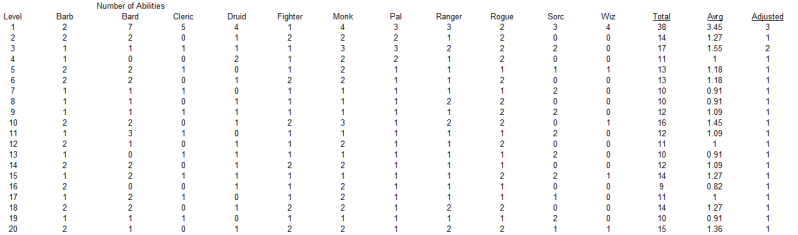
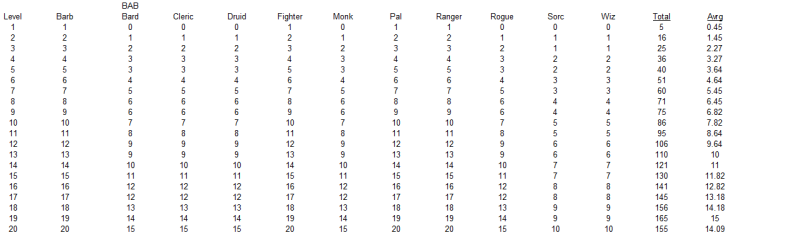
Analysis of Pathfinder Character Class Statistics

So! When I was going over the info for the “Low Fantasy” setting of Pathfinder's single customizable character class concept I did some analysis of what appeared in the classes progression wise.

These are just sheer numbers and it should be noted that a lot of this is my own chicken-scratch in a excel-like program. (Open Office's “Calc”) Some of the data recorded is totally useless but useless data sometimes stimulates my brain when I'm brainstorming.