
I decided to start a video blog. It will cover a lot of things I do on this site. Hopefully I will reach a wider audience :D
http://www.youtube.com/user/oneyeartogo#p/a/u/0/4SNDUGyg9Mg
Tuesday, May 4, 2010

Monday, May 3, 2010
Steampunk LARP Concept
Steampunk LARP
Skills
Vitality 1* (You start with 1 hit point)
Vitality 2 (Your hit points increase to 2.)
Vitality 3 (Your hit points increase to 3.)
Vitality 4 (Your hit points increase to 4.)
Vitality 5 (Your hit points increase to 5.)
Pistol Proficiency [10 Second Reload.]
Revolver Proficiency [30 second reload after up to 6 shots]
Rifle Proficiency [20 Second Reload]
Blunderbuss Proficiency [30 second reload after 1 multi-shot of no more than 6 darts.]
Small Weapon Proficiency* (You must state if the weapon you are using is bladed or blunt when created.)
Bladed Weapon Proficiency
Blunt Weapon Proficiency
Great Weapon Proficiency (Required using two hands in order to deal damage. You must state if the weapon you are using is bladed or blunt when created.)
Light Armor Proficiency (Grants 1 armor to any limb it covers or the torso)
Medium Armor Proficiency (Grants 2 armor to any limb it covers or the torso)
Heavy Armor Proficiency (Grants 3 armor to any limb it covers or the torso)
Mechanized Armor Proficiency (Grants2 armor to any limb it covers or the torso but it can be upgraded… by SCIENCE!)
Shield Proficiency (Up to Kite Shield Size)
Tower Shield Proficiency (Up to tower shield sized)
Buckler Proficiency (Smaller than a pizza box)
Science! (This skill allows you to use various advanced pieces of technology. It is not specialized, but if you are trained it “Science!” you can at least glean some form of information on its design or make use of it in some limited fashion.)
Engineering (This skill allows you to use various advanced weaponry or at least identify how one WOULD use it.)
Repair (It takes 1 minuet of uninterrupted role-playing to recover 1 point of armor to one area. To repair a broken weapon it takes 5 minutes of roleplay.)
Upgrade: Armor Plating (You may increase the armor value of mechanized armor by 2. It counts as heavy armor for the purposes of negating bullet damage. You must purchase the necessary armor plates. This MUST be stylized on the armor.)
Upgrade: Mechanized Reloader (Once per day you may reload and fire your next shot as soon as you are physically able to. You must purchase the necessary mechanized reloader. This MUST be stylized on the armor.)
Upgrade: Chainsaw Edge (Any blows from a bladed weapon upgraded with this automatically deal 2 damage to armor. You must purchase the necessary mechanized chainsaw parts for the weapon. This MUST be stylized on the weapon. )
Upgrade: Pneumatic (Any blows from a blunt weapon upgraded with this automatically destroy a weapon once per day per time upgraded with this upgrade. You must call “Pneumatic !” when you’re using this technique. Missed swings to not expend this. You must purchase the necessary Pneumatic parts for the weapon. This MUST be stylized on the weapon. )
Upgrade: Anti-Artillery Plating (By adding a layer of tank plating to the front of a shield, it becomes sufficiently thick enough to ignore ALL bullet damage. If the shield is hit with a bullet, they do not take the 1 damage to the limb the shield is using. This must be stylized on the shield. It may not be added to a Buckler.)
Pseudoscience (This skill allows you to use various bizarre fringe technology or at least identify how one WOULD use it.)
Detect Paranormal (After one minuet of roleplaying setting up a pseudoscientific display you may call out “I detect all unnatural presence before me!”. This has various effects dependent on the unnatural element.)
Reverse Paranormal Influence (After one minuet of roleplaying enacting a pseudoscientific experiment you may call out “I expel all unnatural elements before me!”.)
Medical (This skill allows you to use various medical technology or at least identify how one WOULD use it.)
First Aid (By roleplaying 1 minuet of aid to a character at zero hit points you can restore them back to one.)
Medical Treatment (By roleplaying two minutes of aid to an injured character . (Note: not an unconscious character) you can restore one hit point to them.
Diagnosis (A character with this skill can diagnose what's wrong with another. They may whisper a question such as “are you poisoned?” and the character may respond in the same fashion to the best of their knowledge. This is out of game talk to represent the character in-game knowledge. It takes 30 second to diagnose but after those 30 seconds you may ask as many questions as you wish.)
Augmentation (This skill allows you to use various bio-technological components or at least identify how one WOULD use it.)
Embedded Automatic Defibrillator (When your heart stops a rather unpleasant jolt fries your ticker to attempt to keep it ticking again. As soon as you are reduced to zero hit points you must fall to the ground. After the one minuet of bleeding out expires you sit back up at one hit point… and in extreme pain. This can only occur once per event. This must be stylized as part of your costume. This requires the correct components to create. The surgery for this takes place between events.)
Mechanized Arm (One of your arms is no longer of flesh and blood. It is permanently grafted with a one handed melee weapon. It can’t be destroyed or detached. That limb automatically has 6 armor but when that armor is destroyed the limb is useless until repaired to at least 1 armor. This must be stylized as part of your costume. This requires the correct components to create. The surgery for this takes place between events.)
*You start with these skills.
Guns
Guns are approved by staff and are Nerf (or an equivalent brand. Homemade guns will be approved on a case by case basis). They MUST be stylized to fit the setting. You may use any gun so long as they fit the following criteria:
-It only fire 1 shot within the determined reload time. (except for the Blunderbuss)
-You must roleplay the reload time of your weapon, uninterrupted and unmoved. Any interruption (a blow or moving from your spot for example) causes you to have to restart the reload.
-Pistols & Revolvers must shoot no further than 10 feet on average.
-Rifles & Blunderbuss have no limit on range.
-A shot that hits a limb will result in reducing a person to 1 vitality and that limb is stunned.
-If heavy armor is hit it instantly reduces it to zero armor but the area it hit is still fine.
-A shot that hits the torso will result in an instant death.
-Guns may NEVER be used in melee in any capacity. Using it in melee WILL result in your instant death and repercussions from staff.
-Ammunition must be bought. You don’t need to use different darts each time- but you DO need to keep track of how much ammo you are using.
Weapons
Any melee weapon must be made according to our guidelines. (Boffer/Latex) This is a lightest touch system- ANY bodily contact will be sufficient to deal damage. Any blow from a weapon (regardless of weapon type) deals one point of damage. The head is NEVER a legal target. Contact with a weapon during a blow is sufficient to negate any damage.
Armor
Armor provides extra HP to the body-part it covers. (Left/Right Limbs and torso). Armor goes before any HP. After it is damaged- it takes the skill “repair” to restore it.
Shields
Shields block all incoming melee and bullet damage. In the case of bullets- it is assumed that the bullet still goes through the shield but because it goes through it the damage is not sufficient enough to kill the target. If a shield gets hit with a bullet- that limb takes 1 point of damage. Tower shields and shield upgraded with the Anti-Artillery upgrade are thick enough to ignore this damage.
Injury/Death
Each weapon blow is one damage. Each bullet shot to a limb reduces you to 1 hp and stuns your limb. A bullet shot to your torso instantly kills you. If you are reduced to 1 hp, any blow to a limb stuns it until you get 1 point of healing in any fashion. In order to die- the final blow must land on your torso.
After you are reduced to zero hit points by a blow to the torso means you are bleeding out. You are unconscious (aka: bleeding out) for 1 minute. If anyone starts to attempt to administer first aid this stops the timer and resets it while they are healing you. If they are interrupted you start to bleed out again. After one minute you make your way to the fate room and draw your card to see if you return back to life.
When you die, it is not the end. You go to the cast area and draw from the deck of fate. They will dictate what happens to your character. More often than not you will return to the land of the living by the
Plot
“I’ve seen some sick things kids. Some really sick things- but nothing as sick as you lot. The world’s going to hell and you’re profiteering from it? You all must have a screw loose or two to shack up on that heap like the “Heart-Warmer” with a person like Dr. Goodfellow. Into the fray he says! “For money! For love! For the sake of living he says!” Watch out for number one so you don’t step in number two is all I say! The Britannia Empire has a price on his head and if you step foot on his ship you do to!”
The world is at total war and you’ve shipped up with Dr. Goodfellow on his ship “The Heart-Warmer”. His crew of mercenaries gets contracts to attack other ships in a pirate-like fashion. They have no side except for those who pay them the most. Sometimes they are hired for other type of jobs. Most of the time their contracts are not made public as officially they have been declared war-criminals by both sides and hiring them would be an offence.
The Great Harvest God
A great, malicious, chaotic god of madness lies beyond the reaches of mortal perception. His influence on the world is profound despite the fact that he is currently not yet born. It is merely the fact that he WILL be born that influences the world. His impending coming adds an element of chaos to the world- making unnatural things occur. (This is basically the plot’s “A Wizard Did it”. It is reminiscent of our favorite Lovecraftian horror.)
Tuesday, April 27, 2010
Mass Combat Part 1
Squad Template
Squads represent rank and file of Small or Medium creatures that would not be particularly dangerous in small groups, but can be terrible foes when gathered in sufficient numbers. For game purposes a squad is defined as a single creature with a space of 30 feet—gigantic hordes are actually composed of dozens of squads in close proximity. A squad has a single pool of Hit Dice and hit points, a single initiative modifier, a single speed, and a single Armor Class. It makes saving throws as a single creature.
A squad of small creatures consists of approximately 15 non-flying creatures or 7 flying creatures. A squad of medium creatures consists of 30 non-flying creatures or 10 flying creatures. Squads of non-flying creatures include many more creatures than could normally fit in a 20-foot square based on their normal space, because creatures in a squad are locked in rank and file. They have no penalty due to this close quarters fighting because they are generally trained to fight shoulder to shoulder when moving or attacking. Larger squads are represented by multiples of single squads. A large squad is completely shapeable, though it usually remains contiguous.
Creating a Squad
"Squad" is an acquired template that can be added to any small or medium creature, magical beast, or undead. (referred to hereafter as the "base creature"). This creatures must have a sufficient intelligence modifier to benefit from military training (Undead are the exception).
A squad uses all the base creature’s statistics and special abilities except as noted here.
Size and Type: Size and type remain unchanged. Skill points and feats are recalculated based on Hit Dice. The base creature gains the squad subtype.
Hit Dice: A squad's Hit Dice are based on the size of the base creature and multiplied by the number of creatures in the squad. A creature with D8 Hit dice has 30 D8 HP (if the squad is comprised of medium non-flying creatures). You can simplify it by rolling a d8 once and multiplying the result.
A modifier of 1 Hit Die per point of Con over 10 is added after the base Hit Dice are multiplied.
Speed: Same as the base creature.
Armor Class: Same as the base creature.
Attack: A squad attacks as one cohesive creature. It receives a “Squad Size” bonus equivalent to the number of creatures remaining in the squad. (A squad of medium non-flying creatures has a +30). This bonus applies to the Squad’s Base Attack Bonus and strength score.
Full Attack: Same as attack.
Special Qualities: A squad retains all the special qualities of the base creature and those listed below.
Squad Traits: Every time a squad looses Hit Points equivalent to its hit dice it gets a -1 “Squad Size” bonus.
A squad takes half damage from single-target damage spells and double damage from area of effect damage spells. Other spells and effects that may disable, disband, or kill a single squad member will damage the squad equal to its Hit Dice (“killing one member”).
A swarm rendered unconscious by means of nonlethal damage becomes disorganized and dispersed, and does not reform until its hit points exceed its nonlethal damage.
Saves: Same as the base creature.
Abilities: Same as the base creature.
Skills: Same as the base creature.
Feats: Same as the base creature.
Environment: Same as the base creature.
Organization: Solitary, Division (5-20 Squads) or Army (50-100+ Squads)
Challenge Rating: Same as the base creature +10 (Design Note: Needs testing. This is a ballpark)
Treasure: Same as base creature.
Alignment: Same as the base creature.
Advancement: Same as the base creature.
Level Adjustment: --
Bird’s Eye View
Squads are generally meant to hit other squads. They will decimate the majority of player characters (dealing at least 30 damage per turn) unless the player characters are of sufficient level.
Leadership & Orders
A squad must make a successful “Leadership” check. If the squad does not have a leadership score they use their charisma score.
If the squad is at the command of some sort of leadership figure they use the Leadership score of the creature giving the commands in place of their own.
Giving an order is a full round action if it is from a creature outside of the squad. It is a free action if it comes from within the squad.
Orders
“Double Time!”
Leadership DC: 10
The squad has twice it’s movement speed this turn. They a flatfooted until the start of their next turn.
“Charge!”
Leadership DC: 15
The squad makes a charge attack.
“Overrun!”
Leadership DC: 20
The squad makes an overrun attack.
“Flank Attack!”
Leadership DC: 20
The squad deals an additional d10 sneak attack damage. This damage can be applied to other Squads.
“Regroup!”
Leadership DC: 30
On a successful Regroup check the squad gains hit points equal to their hit dice. This also restores a +1
This is a full round action. They a flatfooted until the start of their next turn.
Monday, April 12, 2010
Exposition, Narrative, Insane Clowns, and Daggers You Really Want
*Warning, this is something of a rant*
In my opinion gameplay shouldn't be complimented by roleplaying. It should be the other way around. Game mechanics should be designed around the narrative/roleplaying in the game.
One of my favorite experiences as a GM was actually running a relatively short-lived D&D 4th edition game with a few of my friends. There was a tale about an “emotional plane” (home-brewed stuff of course) colliding with our. One of the fights was against a “Insanity Elemental”. He had 3 little “invokers” which could activate an “insanity” effect on the players. I knew the players pretty well so I tossed out the rules for “insanity” from the PHB and went for something more abstract. If he successfully effected them with this spell-like ability they would become “insane”. An insane character got a save at the end of their turn (10+ ends) but one of their actions was controlled by the GM. (Movement, standard, free, ect) By describing the various things that MADE THEM INSANE I didn't even have to take the action for them by the end of the fight! For instance, the spell caster had a lava-lamp like thing apparently smothering him so the only obvious answer to his character was to magic-missile himself in the face to get it off. (his choice- not mine) Another one actually took off his armor and got naked due to the apparent seething flames belching forth from his armor. It was an example of rules almost coming about as a result of good roleplaying.
In that same campaign the players where effected by a “Lust Elemental” who compelled every member of the party to seek out “the dagger”. The players didn't know WHAT “the dagger” was but (as our mantra became that session) they “really wanted the dagger”. EVERY question about it ended with the line “...but/and you really want the dagger.”. Even when the players where doing something completely unrelated I would bug them for a moment and say something like:
“Hay Andrew“
“What?”
“Do YOU want the dagger?”
“Um.. I don't know? Do I?”
“Yes... you want the dagger”
“STILL”
“Yes.”
“Hay Alissa“
“O god...”
“Do YOU want the dagger?”
“*Sigh* Yes”
“That's right... you want the dagger”
This went on for the ENTIRE session, to the point where there was no need to use any in-game mechanics to FORCE them to roleplay a magical compulsion towards the dagger- they simply wanted the dagger. In the end it was actually another lust elemental who had turned herself into a dagger. I didn't even bother to make rules for the magical compulsion- the players just really wanted the dagger. It was an interesting experience, the roleplaying guided the group to almost make rules for themselves. I guess if you paint a vivid enough picture or make something EXCESSIVLY reprehensible then you can guide a game simply by roleplay rather than by clunky rules. Do I think this would work for a group of inexperienced roleplayers? No. The people I had with me where all excellent and where doing this out of sheer enjoyment- but that's how pen and paper games should be right? Just sitting around laughing you ass off while playing a compelling game. To this day when I talk to the players they still something ask “By the way, do I want the dagger?” and all I can do is smile and say “Yes! You REALLY want the dagger.”
Pathfinder Extra
I had an entire campaign written up for a group that never ran so I'll toss it up on the site. I know I've been going on a lot about Pathfinder lately but I've taken a shine to it. It's D&D 3.5 fixed (more or less), kinda like what Hackmaster did to AD&D. I've gotta say- it's pretty fun. I like it a bit more than 3.5 and certifiably bad ass when compared to 4th edition's MMO-ness. (Sure it's quicker... but I'm a fan of rules upon rules upon rules :D I'm a wargammer damn it! Don't screw with the good parts!) What follows is a kinda smattering of the interesting bits from the campaign setting:
Racial Lore: Vættir (Vet-te-ear)
Elves and Dwarves are of the same race (collectively called “Vættir”). Their origins are unclear; however they seem to have been influenced a great deal by magic at some point in their evolution. All Elves are female (in fact in Vættir “Elf” means “Female” generally) and all Dwarves are male. This is something of an extreme example of sexual dimorphism. They generally live in separate communities and more often than not- dislike each other a great deal. (Courtship is extremely difficult…) Vættir never are subject to death though aging- though their bodies do eventually weaken and they become more accident prone. In regards to mixed breeding with other races, the daughter of an elf is always a full blooded elf. A half-elf is always male (and normally laughed very hard at by Dwarves). The son of a Dwarf is always a Dwarf. The daughter of a dwarf is a half dwarf (Counted as “Halfling” but has the familiarity with the weapon family “Dwarf” instead of Halfling). It should be noted that half-breeds are sterile.
Homebrewed Special Rules:
“Only wicked shall perish.”
Those who revere the Divine Father (or whatever deity you are interested in) are subject to his protection. In his eyes, those who are wicked (even temporarily) are undeserving of his graces. Those who uphold his tenets and act in the name of justice should never fear the blade of the wicked. To represent this characters that follow the Divine Father stabilize on charisma roll of 15+ if they are of the good alignment. If they are neutral they use the normal rules for going below zero. Players who worship the Divine Father who fall to the evil alignment instantly die when they reach zero hit points. Following another deity shifts you to evil alignment to evil (as you have betrayed your deity). The Divine Father objects to his people using any other deity’s power. Willfully seeking the blessing of another deity shifts your alignment towards Evil. To the Divine Father, Magic is a sick blight on the planet- tainting pure ideals with it’s influence. Using a magic automatically shifts your alignment towards Evil.
“All things are temporary.”
In this setting alignment is a shifting aspect of one’s personality. An evil act could easily drop a character from a good alignment to a neutral or possibly evil alignment depending on its severity. However, more redemption is just easily obtained.
“Magic is learned, not earned.”
Spell casting classes must be multi-classed into. You must find a teacher as a prerequisite. (This also goes for the magical rogue talents and all magic feats.)
“Burn the Witch!”
The exception to the above rule is Sorcerer. Sorcerers are generally looked upon with disdain, their raw magical talents are (especially in some parts of the world) looked upon as an inherent impurity. If you wish to play a Sorcerer you must do so at first level.
-The Divine Father (LG)
Domains: Glory, Good, Law, Healing, War, Nobility
Mysteries (Oracles): Battle, Heavens
Favored Weapon: Longsword
Design notes on the above:
Feel free to change the fluff, the constantly changing alignment is fun as well as the “only the wicked shall perish”. Note that Paladins are almost REQUIRED to be psycho good if you implement to this. Falling is not only possible but is very easy, roleplaying is a lot of fun for this. You might want to power them up a bit if you do use this with in-game intensives (like gear). In my campaign setting it was a requirement to be from a very prominent kingdom where a good part of the story takes place in.
I also think magic is all to often just “tossed” into games without much thought. I am a proponent of making magic “something fantastic”. This allows players to feel a sense of accomplishment when they are using it and don't just take it for granted. Alternatively it makes them go “OHHHHH GOD!” when they see an enemy tossing around powerful spells.
It's a real treat for the players emotionally and roleplaying-wise when there is a very polarizing issue in the game. In the campaign I wrote with these elements magic was flat out despised in certain areas where others where dandy with it. Casting magics in any kingdom under the influence of the Divine Father could land you in jail or just out and out killed on the spot. Keep in mind that gameplay should be PART of the roleplaying experience- not a cut scene battle :D
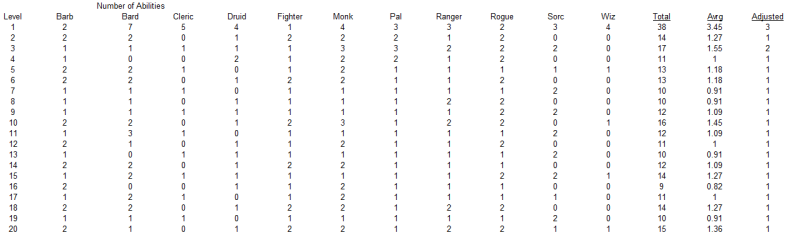
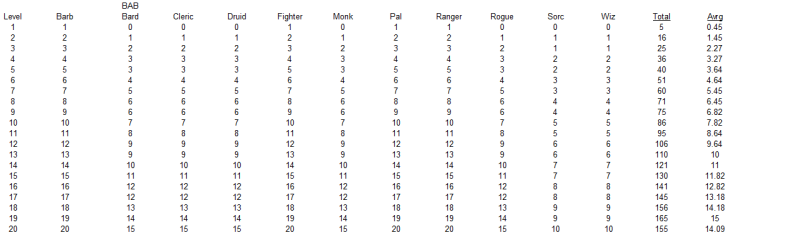
Analysis of Pathfinder Character Class Statistics
So! When I was going over the info for the “Low Fantasy” setting of Pathfinder's single customizable character class concept I did some analysis of what appeared in the classes progression wise.
These are just sheer numbers and it should be noted that a lot of this is my own chicken-scratch in a excel-like program. (Open Office's “Calc”) Some of the data recorded is totally useless but useless data sometimes stimulates my brain when I'm brainstorming.


These are just sheer numbers and it should be noted that a lot of this is my own chicken-scratch in a excel-like program. (Open Office's “Calc”) Some of the data recorded is totally useless but useless data sometimes stimulates my brain when I'm brainstorming.

Game with Meaning- Nobyl'
It's always been my belief that meaning comes from three things. Immersion, emotional attachment, and story. The three elements are quite interconnected so to define them could help. A player needs to be immersed in the story, weaving narrative into exposition so that game-play doesn't get in the way of a players personal connection to the story. Players need to develop an emotional attachment to the elements involved in the plots. In this regard the farther elements from the narrative get away from things they can personally relate to the less emotionally connected they are. (Players are more likely to connect to the plight of a puppy then to the plight of Slab Bulkhead the space marine from Mars) The narrative or story is the unifying thread that runs between the two- it is rather hard to create an earnest emotional connection or retain a high degree of player-immersion without a narrative. There is “Jenga” style personal connection to something YOU made, but a game concept that relays on that alone will be on wobbly feet indeed. It is with this in mind that I put forth the following game concept.
A narrative driven story that revolves around a member of a military reconnaissance unit during April 1986. Due to the rise of Mikhail Gorbachev in Russia and because of based on bad intelligence as to the exact nature of the United States sends in a recon unit to gather intelligence on a power plant in Prypiat, Ukraine. The player makes user-generated characters to fill out an Airborne United States Army Special Forces unit that the player brings up from basic training to their special ops training, all the way to their first real mission in Prypiat. I chose to employ user-generated content because when someone MAKES something it becomes a good deal more relatable. It should also be noted that user-generated content is a double edged sword. A player's initially reaction is to put whoever they may into a frilly pink dress, give them a mustache and a 5 o'clock shadow. This game would give them a LIMITED amount of control (height, weight, facial elements, eye color, voice style, hair color, hair style, names from a list). Each character “spot” would have a background narrative explained via dialogue during the narrative. One might be a hick farm boy from the south while another might be a rich-boy gamer from the north who wants to act out his violent fantasies for real. Each spot would be tailor made to be relatable to a major demographic in the United States.
The characters eventually make it to an air-drop in Prypiat where they have to establish a observational perimeter around the power plant and gather as much intelligence as possible. (By “looking” at various targets) It should be noted that players are given a gun and showed how to use it, as well as a side arm, combat knife, and hand to hand but they only have to fire it once or twice. This is a narrative driven story rather than a combat driven one.
The real emotional part of the story is the characters are actually observing Chernobyl Nuclear Power Plant when it goes off. They must watch as the citizens of Pripyat die slowly without giving away their cover. The US government refuses to pick them up- they are a covert operation and they can't just swoop in while the world's eyes are on them. You must also deal with the traumatic death of your squad mates. To make the story more immersive the game never out and out says “ Chernobyl” until it blows. It just refers to it as “the Pripyat Power Plant” and makes little mention of it's nuclear properties. This is so the players don't immediately make the connection.
Near the end of the game the player, now the only surviving member of the squad, decides to break his cover and attempt to save as many people from the spreading nuclear cloud as possible. (The Russians where VERY slow in alerting them to the real nature of the disaster and as a result. Waiting until 2p.m. on 27 April to really get started) The game ends with the player's character running out into the streets shooting off his gun trying to get people to flee- shouting out a warning before finally succumbing to his radiation exposure. The music plays him out on the Ballard of the Green Berets.
The goal of this game is not only to use the close personal connections for players, but also to educate the world on the shortcomings of the Soviet government in handling this accident. It would be as historically accurate as possible.
Subscribe to:
Posts (Atom)
